


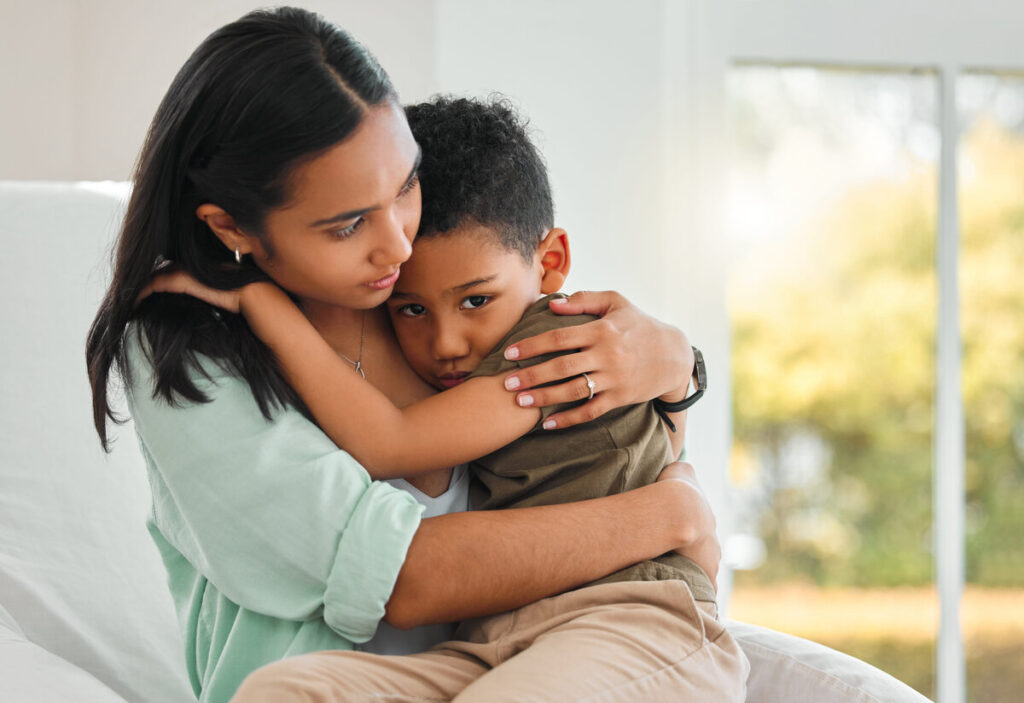
When Worry Takes Over: Understanding Anxiety in Kids
Parenting an Anxious Child can feel scary and lonely, even though anxiety is very common in kids. It can show up in loving, stable homes, too. Anxiety isn’t proof you’ve done something wrong. It’s often a mix of temperament (how a child is wired), stress, life changes, school pressure, and a brain and body that are still learning how to handle big feelings.
All kids worry sometimes. Typical worry comes and goes and usually doesn’t stop them from doing most everyday things. Anxiety is different: the fear feels out of proportion, sticks around, and starts getting in the way. You might see more tears, more arguments, or more “I can’t” moments–especially around school, sleep, or separation. This is common with school-related anxiety – anxiety children experience when tests, friendships, or performance start to feel like too much.
Anxiety doesn’t always look like fear. For many kids, it shows up as:
- Irritability or sudden anger
- Clinginess or trouble separating
- Perfectionism (“If I can’t do it perfectly, I won’t do it.”)
- Avoidance (stalling, refusing, “forgetting”)
- “Acting out” that’s really stress spilling over
One kid-friendly way to explain anxiety is to talk about the body’s “alarm system.” Sometimes that alarm goes off when there’s no real danger–like a smoke detector that’s too sensitive. Their body may jump into fight, flight, or freeze.
Strong support for an anxious child starts with calm, steady adults. When parenting anxious kids, predictable routines, spending less time stuck in reassurance and anxiety loops, and practicing simple child coping skills can help kids feel safer and more capable over time.
Signs to Watch For: Emotional, Physical, and Behavior Clues

Anxiety can look different from one child to the next, and it can shift as they grow. The goal isn’t to treat every worry like a crisis. It’s to notice patterns–especially when fear starts running the show in choices, sleep, school, or friendships.
Emotional clues
- Frequent reassurance-seeking (“Are you sure?” “What if…?”) that comes back quickly after you answer
- Fear of mistakes, perfectionism, or intense guilt after small errors
- Big worries about safety (getting sick, something bad happening, disasters)
- Social fears (being judged, embarrassed, left out)
Physical clues
- Stomachaches, headaches, nausea, or “I don’t feel good” before school or events
- Fast heartbeat, shaky feelings, sweating, or shortness of breath
- Trouble falling asleep, nightmares, or waking often
- Appetite changes (eating much less or more)
Behavior clues
- Avoidance: refusing, stalling, or “forgetting” tasks or activities
- Tears or tantrums at transitions (bedtime, drop-off, leaving the house)
- Refusing to go to school, or frequent visits to the nurse
- Constant checking (locks, homework, texts) or lots of procrastination
Common triggers include separation (often younger kids), social situations (often older kids), tests and performance, and health worries. Some kids keep their anxiety hidden by getting very quiet or by overachieving.
If you’re not sure what’s driving it, track a few episodes: what happened beforehand, what your child did, what helped, and what made it worse. Seeing the pattern often makes the next step easier to choose.
What to Say in the Moment: Reassurance That Helps (and What Can Backfire)
When your child is panicking, start with validation. That means naming what you see and showing you’re with them, even if you don’t agree with the fear. Try: “I see you’re really scared,” or “This feels big.” Then add connection: “I’m here. We can handle this together.”
- “I believe you. Your body feels really alarmed right now.”
- “This feels big, and you’re not alone.”
- “We can handle this together. Let’s take one step.”
- “It makes sense you’re worried. What’s the next tiny thing we can do?”

Many parents (for good reason) reach for: “You’re fine,” “Stop worrying,” or “There’s nothing to be scared of.” The catch is that repeated reassurance can turn into a loop: your child feels anxious, asks for certainty, feels better for a moment, then the worry returns and they ask again. Over time, their brain can start learning, “I can’t cope unless someone proves I’m safe.” That’s one way reassurance and anxiety get tangled.
Instead, try limited reassurance plus a plan. Answer once in a calm, simple way, then shift to coping or problem-solving:
- Answer once: “Yes, I’ll be here at 3:00 after school.”
- Name the pattern: “I notice your worry wants to ask again.”
- Move to a tool: “Let’s do three slow breaths, then we’ll pack your bag.”
Avoid common traps: debating fears (“That’s not logical”), overpromising (“Nothing bad will happen”), rushing (“Hurry up, you’re late”), or shaming (“You’re being dramatic”). When Parenting an Anxious Child, your calm matters as much as your words. Keep your voice low, shoulders relaxed, and movements steady–kids often “borrow” the adult’s nervous system.
Teach self-talk your child can practice: “My worry is loud, but I can still do hard things.” This builds long-term confidence and supports the child coping skills that help with everything from bedtime to the school anxiety children may face.
What to Do Day-to-Day: Routines, Boundaries, and Building Confidence
Daily life can either lower your child’s background stress or keep their alarm system on high. Often, simple routines and steady limits do more than one big talk.
Build predictable rhythms. Aim for regular sleep, meals, homework time, and smoother transitions (like a 10-minute warning before leaving). When kids know what’s coming, there are fewer surprises–and fewer surprises means fewer spikes in anxiety. A short visual schedule or checklist can also help during busy mornings.
Set kind, clear boundaries. Anxiety is real, but it doesn’t get to make all the rules. Try: “I know your worry is loud. The plan is still school. I’ll help you take the next step.” This kind of support for your anxious child protects family life while staying compassionate.
Coach, don’t rescue. Avoiding scary things makes anxiety grow. Instead, help your child face small challenges in tiny steps: walk into the classroom together, then try the doorway, then a quick goodbye. This is a core skill in parenting anxious kids.
Praise bravery and effort: “You tried even though you felt nervous,” and “You stuck with it.”
Create a worry plan: a 10-minute daily “worry time,” a worry notebook, or a worry box.
Limit amplifiers: too much news, scary videos, and caffeine/energy drinks for older kids.
Choose steady family habits: movement, outdoor time, connection, and realistic expectations.
Over time, routines and teaching coping skills can reduce the need for constant checking and loosen reassurance and anxiety loops by building real confidence.

Child Coping Skills That Work Best: Tools to Practice When They’re Calm
These skills work best when you practice them during calm moments–not only in the middle of a meltdown. Coping is like learning to ride a bike: short, repeated practice helps your child’s body remember what to do when anxiety spikes.
Breathing tools (simple and fast)
- “Smell the flower, blow the candle.” Breathe in through the nose (smell), then blow out slowly like a candle. A longer exhale helps the body shift into calm mode.
- Box breathing. Inhale 4, hold 4, exhale 4, hold 4. Trace a square with a finger while you count.
- Longer exhale. In for 3, out for 5 (or in for 4, out for 6). Keep it gentle, not forced.
Body-based skills (move anxiety out of the body)
- Progressive muscle relaxation. Tighten a muscle group (hands, shoulders, legs) for 5 seconds, then release.
- Stretching or a wall push. Push hands into a wall for 10 seconds, release, repeat. It gives the body “work” to do.
- Five-senses grounding. Name 5 things you see, 4 you feel, 3 you hear, 2 you smell, 1 you taste.
Thought skills (talk back to “what-if”)
- Spot “what-if” thoughts. “What if I throw up at school?” is a worry story, not a fact.
- Name the worry. “That’s my worry voice.” Naming creates a little space.
- Choose a more balanced thought. “I might feel nervous, and I can handle it. I can ask for help.”
Try coping cards your child can keep in a backpack: “I can do hard things,” “Feelings are not facts,” “One step at a time.” For problem situations, teach a simple process: define the problem, brainstorm options, pick one, try it, review.
You can also create a calm-down kit: a fidget, drawing supplies, a music playlist, a comforting scent, a small snack, and water. Then make a practice plan: 3-5 minutes daily (after school or before bed) so these tools are ready when stress hits.
School Stress and School Anxiety in Children: Working With Teachers Without Blame
Many kids who seem “fine” at home struggle at school. Common school anxiety children face includes separation at drop-off, test pressure, presentations, social worries (who to sit with, being judged), bullying, and perfectionism. It helps to treat school anxiety as a problem you can work on–not a character flaw.
Make mornings easier. Anxiety often spikes when kids feel rushed. Try packing backpacks and laying out clothes the night before, using a simple checklist, waking up 10-15 minutes earlier, and building in 5 minutes of calm connection (a cuddle, a short chat, a song) before you head out.
Create a drop-off plan. Long goodbyes can accidentally feed worry. Use a brief goodbye, a consistent script (“I love you. You’re safe. I’ll see you at 3:00.”), and a predictable handoff routine (walk to the same spot, high-five, then the teacher takes over). Avoid repeated returns to the classroom, even if your child begs–this can keep a reassurance and anxiety cycle going.
Collaborate with the school. Ask for a meeting with the teacher or counselor. Share patterns you notice (days, subjects, transitions) and ask what they see. Agree on a simple plan for supporting your anxious child, such as:
- a designated check-in person
- a break pass (short, timed breaks)
- seating changes or a “safe seat” near the door
- reduced make-up work after absences
Build gradual exposure. With parenting anxious kids, aim for small steps toward attendance and participation: entering the building, staying for first period, answering one question, giving a short presentation to a teacher first. These steps build confidence through practice and reinforce child coping skills.
If anxiety is significantly affecting learning, attendance, or grades, ask about formal supports like a 504 plan or an IEP (school plans that can provide accommodations and services).
When Anxiety Gets Bigger: Red Flags and When to Get Extra Help
Most kids worry sometimes. But when anxiety starts taking over, extra support can make a real difference. Reaching out isn’t a failure in Parenting an Anxious Child–it’s a way to care for your child and your whole family.
Consider professional help if you notice:
- Frequent school refusal or constant battles at drop-off (common with school anxiety children experience)
- Panic symptoms (racing heart, shaking, shortness of breath, feeling “out of control”)
- Major sleep problems (can’t fall asleep, frequent waking, or exhaustion)
- Constant physical complaints (stomachaches, headaches), especially before school or activities
- Severe avoidance (won’t go places, try new things, or be away from you)
- Talk of self-harm or not wanting to be alive
Also look at duration and impact: anxiety most days for weeks, family life shrinking, or your child struggling with age-expected tasks (sleeping alone, attending school, playdates). If your family feels stuck in constant reassurance and anxiety loops, that’s another sign to get more support for your anxious child.
Where to start: your pediatrician, a school counselor, or a licensed therapist. Bring specific examples (what happens, how often, triggers, what helps).
What therapy may involve: CBT (cognitive behavioral therapy) helps kids notice worry thoughts and practice new responses. Exposure therapy means facing fears in small, planned steps so the brain learns, “I can handle this.” Many therapists also provide parent coaching, which can be especially helpful in parenting anxious kids while building child coping skills.
Medication: Sometimes medication is used, usually alongside therapy. Discuss risks and benefits with a qualified prescriber.
If you have any safety concerns (self-harm, threats, immediate danger), call 911, go to the ER, or contact a crisis line right away.
Putting It All Together: A Simple Plan for Parenting an Anxious Child
When Parenting an Anxious Child, it can help to think in three steps: connect (validate the feeling), coach (practice skills), and gently challenge (take small brave steps). Anxiety may not fade quickly, but your child can get better at moving through it.
- One coping practice: 5 minutes of breathing, grounding, or coping cards (to build child coping skills).
- One small exposure goal: a planned step toward what they avoid (a key part of parenting anxious kids).
- One school check-in: a brief email or plan to support school anxiety children may face.
- One family reset: a walk, a game, or a screen-free meal.
Expect setbacks. When they happen, go back to basics and try to avoid all-or-nothing thinking. For you, a 60-second breathing break can help, along with leaning on your support network and keeping consistent messages between caregivers. Progress often looks like showing up and recovering faster–not having zero worry. Many kids improve with steady anxious child support, less time spent in reassurance and anxiety loops, and extra help when it’s needed.